Programs Offered
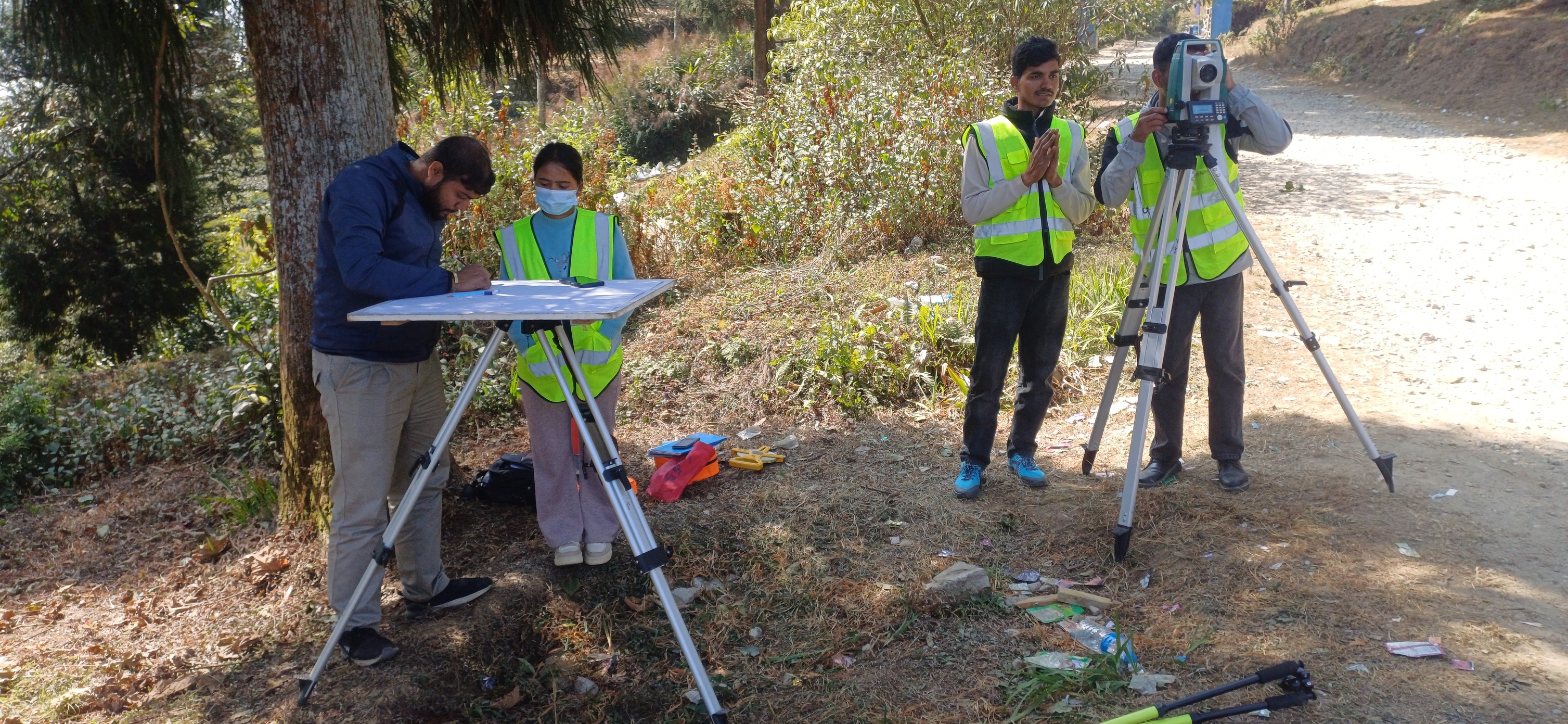
Bachelor in Civil Engineering
Introduction: Manmohan Technical University (MTU), Faculty of Engineering is offering this course to produce higher level technical manpower capable to undertake the works in the field of Civil Engineering. This curriculum is designed with the purpose of producing high level technical manpower equipped with knowledge and skills related to the field of Civil Engineering to meet national and international demand for economic and infrastructure development. The knowledge and skills incorporated in this curriculum will be helpful to deliver the individual, national and international needs in the field of Civil Engineering. Title of course: Bachelor in Civil Engineering (BCE). Program Objectives: The Curriculum has following objectives to: To train students in technical and analytical skills and prepare engineers who are capable of undertaking works in civil engineering field, a as Civil Engineer, under Road, Irrigation, Water supply, Urban Development and Building Construction and other civil infrastructures development related departments and sectors. Produce high level competent technical human resources in the field of civil engineering; Prepare technical workforce who will demonstrate positive attitude and respect for the profession and socio-cultural human values. Help in meeting the demand of qualified Civil Engineers for public and private infrastructure development sector in national and international field. Reduce the dependence on employing such engineers from foreign countries, Create self-employment opportunities with research activities. Duration: The total duration of this curricular program is Four years. Each year consists of two semesters of six months each. Moreover, one semester consists of 90 working days (15 academic weeks approximately) including evaluation period. Target group: The target group for this programme will be all interested individuals who passed (10 +2) class with Physics, Chemistry and Mathematics of 200 marks or equivalent or Diploma in Engineering. Eligibility and Admission: The admission procedure consists of an entrance examination conducted by MTU. To be eligible to appear in the entrance examination, the candidate must have a minimum score in (10+2) or Diploma in Engineering (or equivalent) examinations with minimum of 50% marks in aggregate and 50% in Physics, Chemistry and Mathematics (PCM). OR Minimum 2.4 GPA in aggregate and minimum C+ in Physics, Chemistry and Mathematics (PCM) and minimum C in other subjects. Students who have completed (10+2) in Biology stream must have taken additional mathematics course and passed it with cumulative PCM of 50% or 2.4 GPA to be eligible for the indicated program. Selection: A candidate must pass the entrance examination conducted by the university and be selected on merit basis to enroll in the university. Medium of instruction: The medium of instruction will be in English except stated otherwise. Pattern of attendance: Minimum of 80% attendance in each subject is required to appear in the respective final examination. Course Structure SN Course Code Subjects Credit First Year - First Semester 1 EG401SH Engineering Mathematics I 3 2 EG402SH Engineering Chemistry 3 3 EG403SH Engineering Physics 3 4 EG404ME Engineering Drawing I 2 5 EG405CO Computer Programming 4 6 EG406EE Basic Electrical and Electronics Engineering 4 Total 19 First Year - Second Semester 1 EG451SH Engineering Mathematics II 3 2 EG452CE Engineering Mechanics I 3 3 EG453CE Engineering Geology 3 4 EG454ME Workshop Technology 2 5 EG455ME Engineering Drawing II 2 6 EG456CE Civil Engineering Materials 2 7 EG457AR Fundamental of Architecture 3 Total 18 Second Year - Third Semester 1 EG501SH Engineering Mathematics III 3 2 EG502CE Engineering Mechanics II 3 3 EG503EE Strength of Materials 3 4 EG504CE Fluid Mechanics 3 5 EG505CE Building Technology 3 6 EG506EE Computer Aided Building Drawing 3 7 EG507CE Surveying I 4 Total 22 Second Year - Fourth Semester 1 EG551CE Theory of Structures I 3 2 EG552CE Hydraulics 3 3 EG553SH Numerical Methods 3 4 EG554CE Soil Mechanics 3 5 EG555CE Surveying II 4 6 EG556CE Concrete Technology 3 Total 19 Third Year - Fifth Semester 1 EG601SH Probability and Statistics 3 2 EG602CE Transportation Engineering I 3 3 EG603CE Theory of Structures II 3 4 EG604CE Foundation Engineering 3 5 EG605CE Survey Camp 2 6 EG606CE Design of Masonry Structures 3 7 EG607CE Engineering Hydrology 3 Total 20 Third Year - Sixth Semester 1 EG651CE Transportation Engineering II 3 2 EG652CE Design of Steel and Timber Structures 4 3 EG653CE Engineering Economics 3 4 EG654CE Water Supply Engineering 3 5 EG655CE Construction and Project Management 4 6 EG656CE Irrigation and Drainage Engineering 3 7 EG6---CE Elective I 3 Total 23 Fourth Year - Seventh Semester 1 EG701CE Design of Reinforced Concrete Structures 3 2 EG702CE Sanitary Engineering 3 3 EG703CE Hydropower Engineering 3 4 EG704CE Estimating, Costing and Valuation 3 5 EG705CE Project I 2 6 EG7---CE Elective II 3 7 EG7---CE Elective III 3 Total 20 Fourth Year - Eighth Semester 1 EG751CE Professional Practice and Ethics 2 2 EG752CE Work Based Education 3 3 EG753CE Project II 6 Total 11 Grand Total 152 Elective Subjects Elective I 1 EG661CE Structural Dynamics 2 EG662CE Seismic Resistant Design of Masonry Structure 3 EG663CE Design of Suspension Bridge 4 EG664CE Transportation Planning & Engineering 5 EG665CE Fundamental of Rock Mechanics 6 EG666CE Soil Conservation and Watershed Management 7 EG667CE Geo Hazards 8 EG668CE Time Series Analysis 9 EG669CE Solid waste Management 10 EG670CE Water and Wastewater Quality Analysis Elective II 1 EG711CE Design of Bridges 2 EG712CE Vulnerability Assessment and Retrofitting Techniques 3 EG713CE Earthquake Risk Assessment 4 EG714CE Rock Slope Engineering 5 EG715CE Hill Irrigation Engineering 6 EG716CE Ground Water Engineering 7 EG717CE Advanced Geo-technical Engineering 8 EG718CE Traffic Engineering & Management 9 EG719CE Domestic Water and Waste Water Engineering and Management 10 EG720CE Water Quality Management 11 EG721CE Environmental Impact Assessment Elective III 1 EG731CE GIS & Remote Sensing 2 EG732CE Construction Safety Management 3 EG733CE Procurement Management 4 EG734CE Ropeway Engineering 5 EG735CE Disaster Risk Management 6 EG736CE Climate Change 7 EG737CE Operation Research in Engineering 8 EG738CE Geotechnical Earthquake Engineering 9 EG739CE Post disaster Water and Sanitation Management 10 EG740CE Public Health and Risk Assessment 11 EG741CE Railway Engineering Bachelor in Civil Engineering
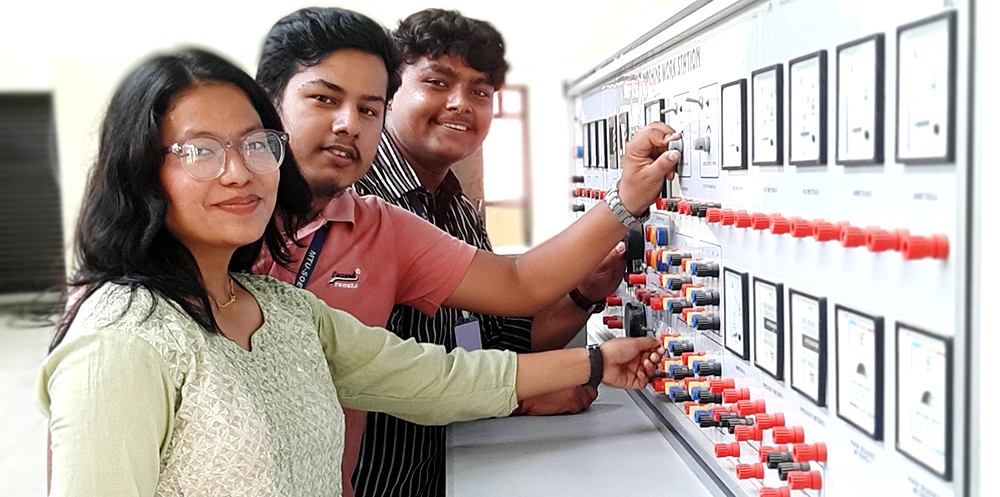
Bachelor in Electrical and Electronics Engineering
Bachelor in Electrical and Electronics Engineering Introduction: Manmohan Technical University (MTU), School of Engineering is offering this course to produce higher level technical manpower capable to undertake the works in the field of Electrical & Electronics Engineering. This curriculum is designed with the purpose of producing high level technical manpower equipped with knowledge and skills related to the field of Electrical & Electronics Engineering to meet national and international demand for economic and infrastructure development. The knowledge and skills incorporated in this curriculum will be helpful to deliver the individual, national and international needs in the field of Electrical & Electronics Engineering. Title of course: Bachelor in Electrical and Electronics Engineering (BEExE). Program Objectives: The Curriculum has following objectives to: produce graduates with a strong foundation in the basic sciences and mathematics that will enable them to identify and solve Electrical/Electronic Engineering problems. provide students with a solid foundation in Electrical and Electronics Engineering that prepares them for life-long careers and professional growth in fields of their choice. provide the basic skills to communicate effectively and to develop the ability to function as members of multi-disciplinary teams. provide a broad-based education so that they can appreciate diversity of opinion, better understand ethical issues, and develop a more global perspective. provide a relevant engineering design experience that is integrated across the four-year curriculum which will develop an understanding of the relationships between theory and practice. Duration: The total duration of this curricular program is Four years. Each year consists of two semesters of six months each. Moreover, one semester consists of 90 working days (15 academic weeks approximately) including evaluation period. Target group: The target group for this programme will be all interested individuals who passed (10 +2) class with Physics, Chemistry and Mathematics of 200 marks or equivalent or Diploma in Engineering. Eligibility and Admission: The admission procedure consists of an entrance examination conducted by MTU. To be eligible to appear in the entrance examination, the candidate must have a minimum score in (10+2) or Diploma in Engineering (or equivalent) examinations with minimum of 50% marks in aggregate and 50% in Physics, Chemistry and Mathematics (PCM). OR Minimum 2.4 GPA in aggregate and minimum C+ in Physics, Chemistry and Mathematics (PCM) and minimum C in other subjects. Students who have completed (10+2) in Biology stream must have taken additional mathematics course and passed it with cumulative PCM of 50% or 2.4 GPA to be eligible for the indicated program. Selection: A candidate must pass the entrance examination conducted by the university and be selected on merit basis to enroll in the university. Medium of instruction: The medium of instruction will be in English except stated otherwise. Pattern of attendance: Minimum of 80% attendance in each subject is required to appear in the respective final examination. Course Structure SN Course Code Subjects Credit First Year - First Semester 1 EG401SH Engineering Mathematics I 3 2 EG402SH Engineering Chemistry 3 3 EG403SH Engineering Physics 3 4 EG404ME Engineering Drawing I 2 5 EG405CO Computer Programming 4 6 EG406ME Workshop Technology 2 7 EG407EE Basic Electrical Engineering 3 Total 20 First Year - Second Semester 1 EG451SH Engineering Mathematics II 3 2 EG452ME Engineering Thermodynamics 2 3 EG453ME Applied Mechanics 3 4 EG454SH Modern Physics 3 5 EG455CO Object Oriented Programming 3 6 EG456EE Electrical Installation Workshop 2 7 EG457EE Electrical Engineering Material 3 Total 19 Second Year - Third Semester 1 EG501SH Engineering Mathematics III 3 2 EG502EX Logic Circuit 3 3 EG503EE Electric Circuit Theory 3 4 EG504EX Electronics Devices and Circuits 4 5 EG505EE Instrumentation 3 6 EG506EE Electrical Machine 4 7 EG507EE/EX Minor Project I 1 Total 21 Second Year - Fourth Semester 1 EG551EX Electromagnetics 3 2 EG552SH Applied Mathematics 3 3 EG553SH Numerical Methods 3 4 EG554EE Control System Engineering 4 5 EG555EX Analog and Digital Integrated Circuits 3 6 EG556EX Microprocessors 3 7 EG557EE/EX Minor Project II 1 Total 20 Third Year - Fifth Semester 1 EG601SH Probability and Statistics 3 2 EG602EX Embedded Systems 3 3 EG603EX Digital Control System 3 4 EG604EX Signals and Systems 3 5 EG605EE Power System Analysis 4 6 EG606EE/EX Major Project I 1 7 EG611EE/EX Elective I 3 Total 20 Third Year - Sixth Semester 1 EG651EE Electric Safety and Hazard 2 2 EG652EX Consumer Electronics 3 3 EG653CE Engineering Economics 3 4 EG654EE Power System Protection 4 5 EG655EE/EX Major Project II 1 6 EG657CE Technology, Environment & Society 2 7 EG661EE/EX Elective II 3 8 EG662EE/EX Elective III 3 Total 21 Fourth Year - Seventh Semester 1 EG701EX Advanced Instrumentation 3 2 EG702EE/EX Final Project I 2 3 EG706CE Management for Engineers 3 4 EG711/712EE/EX Elective IV 3 5 EG713-716EE/EX Elective V 3 6 EG717-719EE/EX Elective VI 3 7 EF720-723EE/EX Elective VII 3 Total 20 Fourth Year - Eighth Semester 1 EG751CE Professional Practice and Ethics 2 2 EG752EE/EX Work Based Education 3 3 EG753EE/EX Final Project II 6 Total 11 Grand Total 152 Elective Subjects For Electrical Stream For Electronics Stream Elective I EG611 - EE Electric Machine Design EG611EX - Integrated Communication System Elective II EG661EE - Power Electronics EG661EX - Wireless communication Elective III EG662EE - Illumination Design and Industrial Electrification EG662EX - Database Management System EG663EX - Computer Architecture Elective IV EG711EE - Power Plant engineering EG712EE - High Voltage Engineering EG711EX - GIS and Remote Sensing EG712EX - Antenna and Propagation Elective V EG713EE - Advanced Power System Analysis EG714EE - Applied Photovoltaic Engineering EG715EE - Micro-Hydro Power EG716EE - Wind Energy Conversion System EG713EX - Digital Image Processing EG714EX - Big Data Analytics EG715EX - Information Systems EG716EX - Digital Signal Processing Elective VI EG717EE - Rural Electrification EG718EE - Transmission and Distribution Engineering EG719EE - Reliability Engineering EG717EX - Optical Fiber Communication EG718EX - Microwave Engineering EG719EX - VLSI Elective VII EG720EE - Electrical Energy System Management EG721EE - EV Technology EG722EE - Microgrids EG720EX - Internet of Things (IoT) EG721EX - Artificial Intelligence EG723EE/EX - SCADA and PLC in Industrial Automation

Bachelor in Electrical Engineering
Introduction: Manmohan Technical University (MTU), School of Engineering is offering this course to produce high level technical manpower capable to undertake the works in the field of Electrical Engineering. This curriculum is designed with the purpose of producing high level technical manpower equipped with knowledge and skills related to the field of Electrical Engineering to meet national and international demand for economic and infrastructure development. The knowledge and skills incorporated in this curriculum will be helpful to deliver the individual, national and international needs in the field of Electrical Engineering. Title of course: Bachelor in Electrical Engineering (BEE). Program Objectives: The Curriculum has following objectives to: produce graduates with a strong foundation in the basic sciences and mathematics that will enable them to identify and solve Electrical Engineering problems. provide students with a solid foundation in Electrical Engineering that prepares them for life-long careers and professional growth in fields of their choice. provide the basic skills to communicate effectively and to develop the ability to function as members of multi-disciplinary teams. provide a broad-based education so that they can appreciate diversity of opinion, better understand ethical issues, and develop a more global perspective. provide a relevant engineering design experience that is integrated across the four-year curriculum which will develop an understanding of the relationships between theory and practice. Duration: The total duration of this curricular program is Four years. Each year consists of two semesters of six months each. Moreover, one semester consists of 90 working days (15 academic weeks approximately) including evaluation period. Target group: The target group for this programme will be all interested individuals who passed (10 +2) class with Physics, Chemistry and Mathematics of 200 marks or equivalent or Diploma in Engineering. Eligibility and Admission: The admission procedure consists of an entrance examination conducted by MTU. To be eligible to appear in the entrance examination, the candidate must have a minimum score in (10+2) or Diploma in Engineering (or equivalent) examinations with minimum of 50% marks in aggregate and 50% in Physics, Chemistry and Mathematics (PCM). OR Minimum 2.4 GPA in aggregate and minimum C+ in Physics, Chemistry and Mathematics (PCM) and minimum C in other subjects. Students who have completed (10+2) in Biology stream must have taken additional mathematics course and passed it with cumulative PCM of 50% or 2.4 GPA to be eligible for the indicated program. Selection: A candidate must pass the entrance examination conducted by the university and be selected on merit basis to enroll in the university. Medium of instruction: The medium of instruction will be in English except stated otherwise. Pattern of attendance: Minimum of 80% attendance in each subject is required to appear in the respective final examination.

Masters in Power System Engineering
A Master's in Power System Engineering is an advanced professional degree designed to equip electrical engineering graduates with the specialized skills needed to design, analyze, and manage modern electrical grids. As the global energy landscape shifts toward renewable sources and "smart" technologies, these courses focus on bridging the gap between traditional grid operations and future sustainable solutions. M.Sc. Power System Curriculum Structure Year I Semester I EG801EE Computer Aided Power System Analysis (3 Credit) EG802EE Distributed Systems Design and Operation (3 Credit) EG803EE Extra High Voltage AC Systems (3 Credit) EG804EE Power System Dynamics and Stability (4 Credit) EG--EE Elective I (3 Credit) Year I Semester II EG851EE Power System Reliability and Risk Assessment (4 Credit) EG852EE Power Market and Deregulation (3 Credit) EG853EE Distributed Generation and Grid Integration (3 Credit) EG854EE Power System Operation and Economics (3 Credit) EG--EE Elective II (3 Credit) Year II Semester I EG901EE Digital Protection of Power System (3 Credit) EG--EE Elective III (3 Credit) EG905EE Research Methodology (3 Credit) EG906EE *Research Project - Leading to thesis (4 Credit) Year II Semester II EG951EE *Thesis (15 Credit) Total credits: 60 ELECTIVE I 1 [EG805EE] Mathematical Programming 2 [EG806EE] Operation Research and Optimization Techniques ELECTIVE II 1 [EG855EE] FACTS Devices 2 [EG856EE] Switchyard Design ELECTIVE III 1 [EG902EE] Power Quality Improvement 2 [EG903EE] Power Electronics for Renewable Energy Systems 4 [EG904EE] Condition Monitoring and Fault Diagnostics
Latest School Notices
पूर्ण छात्रवृत्ति (Need Based) फाराम भर्ने सम्बन्धी सूचना ।
बिदा सम्बन्धी सूचना ।
Admission Notice for BE Civil Engineering
BE Admission Notice (From Re-Entrance Ranking)
Re-Entrance form Notice for BE Civil and BE Electrical
प्रथम भर्ना सूचिको अन्तिम सूचि प्रकाशन तथा भर्ना सम्बन्धी सूचना ।
Recent news
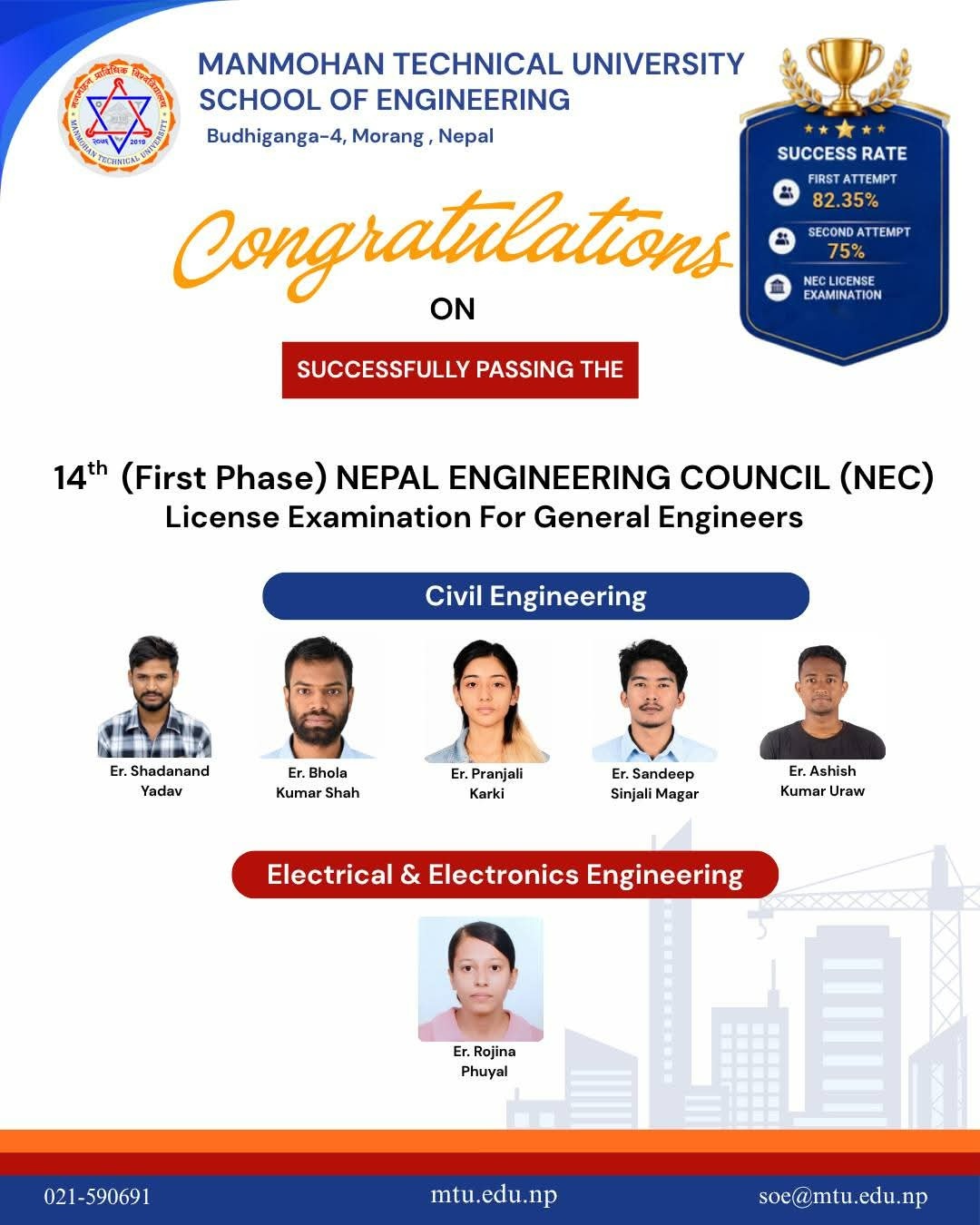
Congratulations 🎉
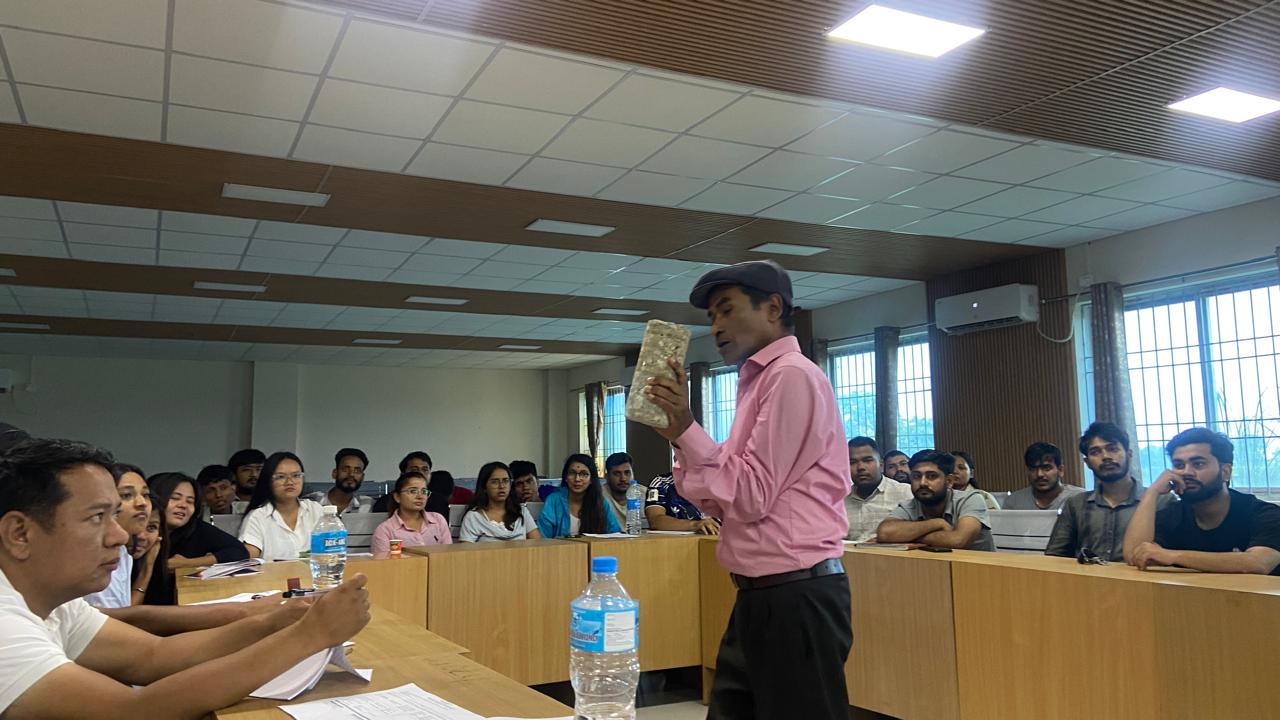
Basic Concepts of Earthquake Resistance and Quality Control of RCC Structures

Manmohan Technical University, School of Engineering Welcomes New Faculty Members
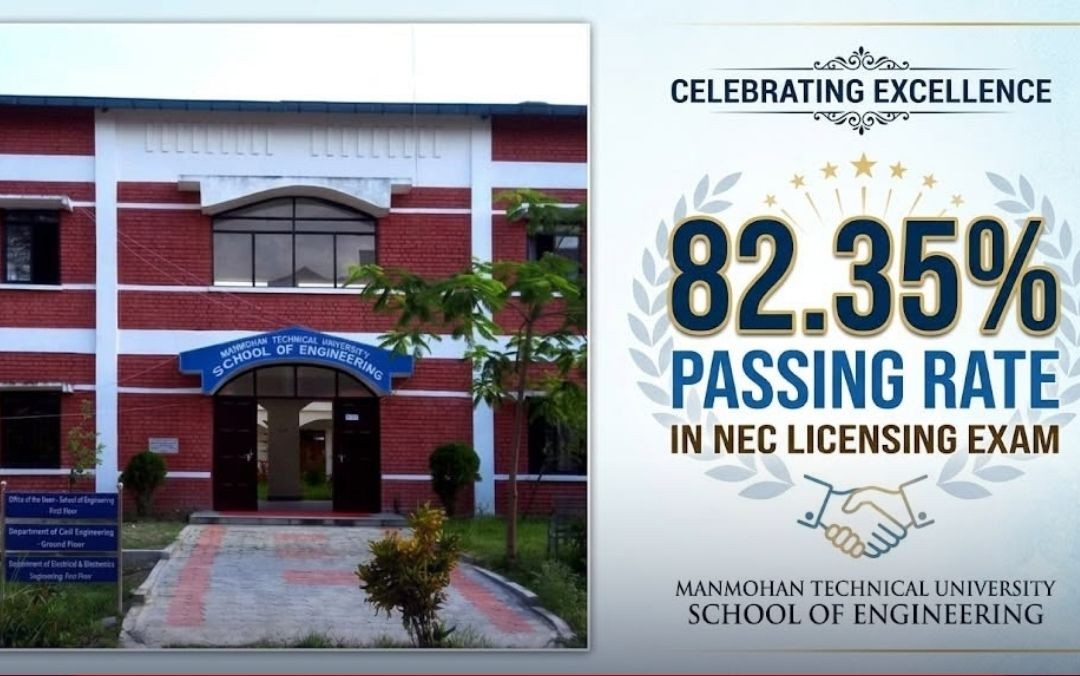
प्राविधिक विश्वविद्यालयका ८२ प्रतिशत विद्यार्थी व्यावसायिक इन्जिनियर बन्न सफल
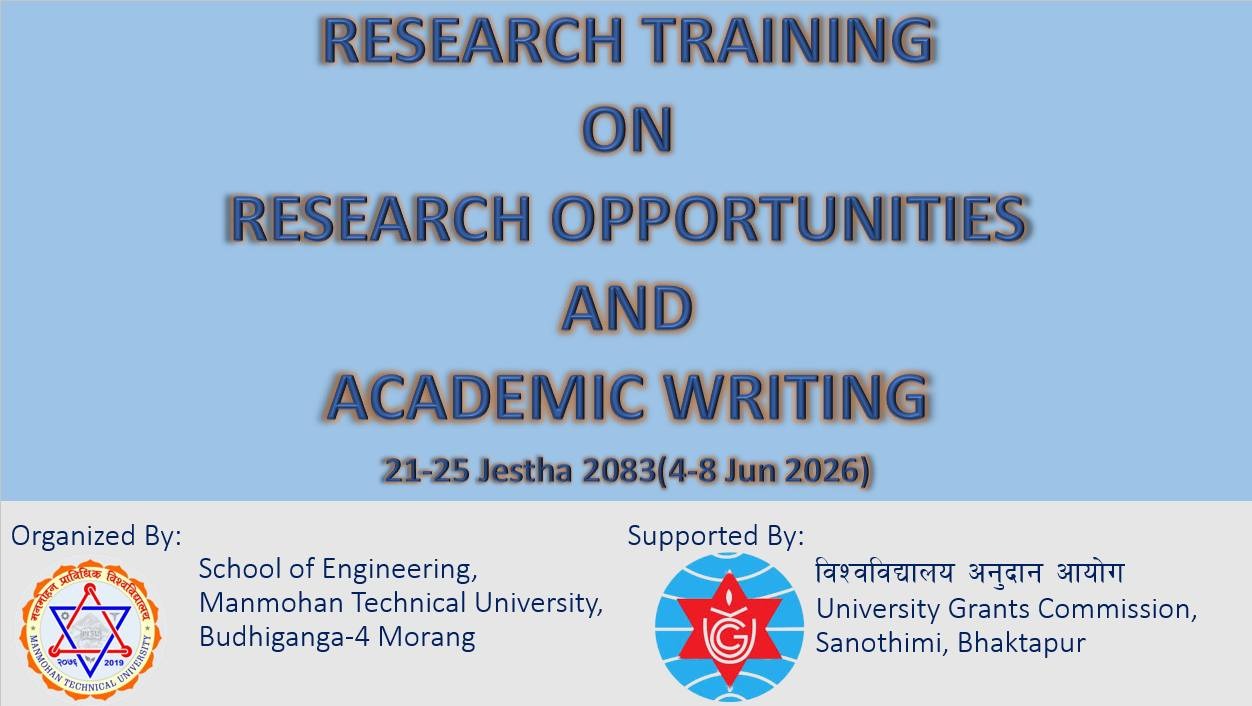
Research Training
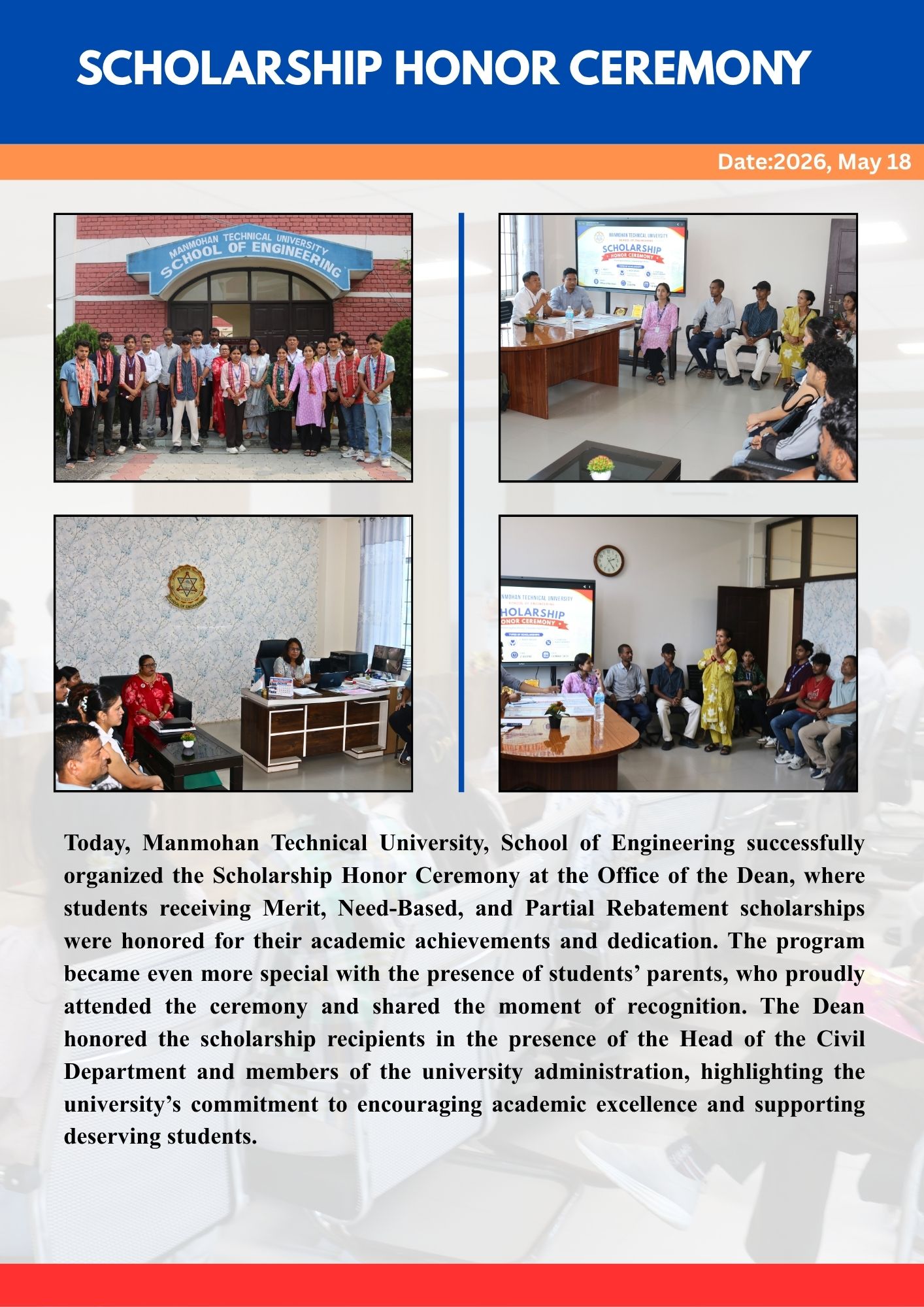
Scholarship Honor Ceremony
Upcoming Events
Message From the Dean

"It is my pleasure to welcome you to the School of Engineering at Manmohan Technical University. Our School has established a robust engineering education system that produces skilled and entrepreneurial engineers. We believe our graduates will excel in applying engineering practices to contribute to both national and global development.
Our curriculum is carefully crafted to balance practical and theoretical courses. The undergraduate programs, such as the B.E. in Civil Engineering and B.E. in Electrical and Electronics Engineering, were launched in 2022, and in 2024, we added the B.E. in Electrical Engineering. Looking ahead, we plan to introduce M.Sc. programs in Structural Engineering and Power System Engineering.
Our academic programs will be further enriched by state-of-the-art research laboratories. For more information, we invite you to visit our website. I also welcome any constructive feedback and suggestions to help us provide the best engineering education in Nepal."
Dr. Rekha Shrestha
Dean
Departments
Department of Civil Engineering
Department of Civil Engineering offers Bachelor in Civil Engineering Program.
Department of Electrical and Electronics Engineering
This department offers Bachelor in Electrical Engineering, Bachelor in Electrical and Electrical and Electronics Engineering and Master of Science in Power System Engineering.